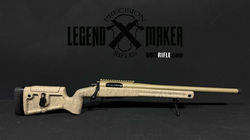
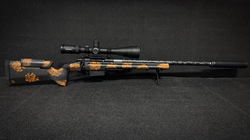
Bolt Rifle
[Login to edit this page]
Typically, a bullet is propelled by the contained deflagration of an explosive compound (originally black powder, later cordite, and now nitrocellulose), although other means such as compressed air are used in air rifles, which are popular for vermin control, hunting small game, formal target shooting and casual shooting ("plinking").
In most armed forces the term "gun" is incorrect when referring to small arms; in the military, the word "gun" means an artillery piece or crew-served machine gun. Furthermore, in many works of fiction a rifle refers to any weapon that has a stock and is shouldered before firing, even if the weapon is not rifled or does not fire solid projectiles. (e.g. a "laser rifle")
Formerly, rifles only fired a single projectile with each squeeze of the trigger. Modern assault rifles are capable of firing more than one round per trigger squeeze; some fire in a fully automatic mode and others are limited to bursts of three to five rounds per squeeze. Thus, modern assault rifles overlap somewhat with machine guns. In fact, many light machine guns (such as the Russian RPK) are adaptations of existing assault rifle designs. Generally, the difference between an automatic rifle and a machine gun comes down to weight and feed system; rifles, with their relatively light components (which overheat quickly) and small magazines, are incapable of sustained automatic fire in the way that machine guns are. While machine guns may require more than one operator, the rifle is an individual weapon.
The origins of rifling are difficult to trace, but some of the earliest practical experiments seem to have occurred in Europe during the fifteenth century. Archers had long realized that a twist added to the tail feathers of their arrows gave them greater accuracy. Early muskets produced large quantities of smoke and soot, which had to be cleaned from the action and bore of the musket frequently; either through the action of repeated bore scrubbing, or a deliberate attempt to create "soot grooves" that would allow for more shots to be fired from the firearm might also have led to a perceived increase in accuracy, although no one knows for sure. True rifling dates from the mid-15th century,[citation needed] although military commanders preferred smooth bore weapons for infantry use due to the fact that rifles were much more prone to problems due to powder fouling the barrel.
Rifles were created as an improvement to smooth bore muskets. In the early 18th century, Benjamin Robins, an English mathematician, realized that an elongated bullet would retain the momentum and kinetic energy of a musket ball, but would slice through the air with greater ease. The black powder used in early muzzle loading rifles quickly fouled the barrel, making loading slower and more difficult. Their greater range was also considered to be of little practical use, since the smoke from black powder quickly obscured the battlefield and made it almost impossible to target the enemy from a distance. Since musketeers could not afford to take the time to stop and clean their barrels in the middle of a battle, rifles were limited to use by sharpshooters and non-military uses like hunting.
Muskets were smoothbore, large caliber weapons using ball-shaped ammunition fired at relatively low velocity. Due to the high cost and great difficulty of precision manufacturing, and the need to load readily from the muzzle, the musket ball was a loose fit in the barrel. Consequently on firing the ball bounced off the sides of the barrel when fired and the final direction on leaving the muzzle was unpredictable. Muskets had to be long so the muzzles of the rear rank’s muskets projected well forward of the faces of the front rank.
The performance of early muskets was sufficient for the styles of warfare at the time, whereby soldiers tended to stand in long, stationary lines and fire at the opposing forces. Aiming and accuracy were not necessary to hit an opponent. Muskets were used for comparatively rapid, unaimed volley fire, and the average conscripted soldier could be easily trained to use them. The (muzzle-loaded) rifle was originally a sharpshooter's weapon used for targets of opportunity and deliberate aimed fire, first gaining notoriety in warfare during the Seven Years War and American War for Independence through their use by American frontiersmen. Later during the Napoleonic Wars, the British 95th Regiment (Green Jackets) and 60th Regiment, (Royal American) as well as American sharpshooters and riflemen during the War of 1812 used the rifle to great effect during skirmishing. Because of a slower loading time than a musket, they were not adopted by the whole army. Since rifles were used by sharpshooters who didn't routinely fire over other men’s shoulders they didn’t need to be long, which made for a handier weapon and also meant that the tight-fitting balls didn’t have too long a distance to be rammed down the barrel.
The invention of the minie balls in the 1840s solved the slow loading problem, and in the 1850s and 1860s rifles quickly replaced muskets on the battlefield. Many rifles, often referred to as rifled muskets, were very similar to the muskets they replaced, but the military also experimented with other designs. Breech loading weapons proved to have a much faster rate of fire than muzzle loaders, causing military forces to abandon muzzle loaders in favor of breech loading designs in the late 1860s. In the later part of the 19th century, rifles were generally single-shot, breech-loading — designed for aimed, discretionary fire by individual soldiers. Then, as now, rifles had a stock, either fixed or folding, to be braced against the shoulder when firing. The adoption of cartridges and breech-loading in the 19th century was concurrent with the general adoption of rifles. In the early part of the 20th century, soldiers were trained to shoot accurately over long ranges with high-powered cartridges. World War I Lee-Enfields rifles (among others) were equipped with long-range 'volley sights' for massed firing at ranges of up to 1.6 km (1.0 mile). Individual shots were unlikely to hit, but a platoon firing repeatedly could produce a 'beaten ground' effect similar to light artillery or machine guns; but experience in World War I showed that long-range fire was best left to the machine gun.
Currently, rifles are the most common firearm in general use for hunting purposes (with the exception of bird hunting where shotguns are favored). Rifles derived from military designs have long been popular with civilian shooters.
During the Napoleonic Wars the British army created several experimental units known as "Rifles", armed with the Baker rifle. These Rifle Regiments were deployed as skirmishers during the Peninsular war in Spain and Portugal, and were more effective than skirmishers armed with muskets due to their accuracy and long range.
0 Comments
Write a comment